

Seasons come and go. In the same way that most good things eventually become forgettable, they blend into the background noise of sports history with respectable records and strong rosters. The Golden State Warriors of 2015–16 are another. Despite breaking a 20-year record and finishing with 73 wins and 9 losses in 82 games, the team managed to leave the NBA Finals without a ring.
This season is so difficult to let go of because of that contradiction. As the reigning champions, the Warriors came into the season with the confidence that comes from having experienced victory. Nobody, probably not even the Warriors themselves, anticipated what was about to happen after Stephen Curry’s incredible season. They won all 24 of their games in a row. Twenty-four. Before December was even halfway over, Golden State surpassed the Houston Rockets’ 1993–94 record for the best start in NBA history.
The atmosphere at Oakland’s Oracle Arena felt different from most championship runs. The sound was not the same. Expectant rather than desperate. Attendees at games appeared to realize they were witnessing something uncommon rather than merely hoping.
The obvious focal point was Curry. During that season, he shot 50% from the field, 45% from three, and 91% from the free-throw line, averaging 30.1 points per game. He broke his own previous record of 286 three-pointers by finishing with 402. When you type out the numbers, they appear almost fictitious. He was ranked first on every voter’s ballot, making him the first unanimous MVP in NBA history. Whether anyone will ever achieve that level again is still up in the air.
However, the team surrounding him merits greater recognition than it occasionally receives in the retelling. With 14 points, nearly 10 rebounds, and 7 assists per game, Draymond Green was playing at a level that most power forwards just can’t match. He was also running the offense when necessary and defending every position on the floor.
While defending some of the top perimeter scorers in the league, Klay Thompson quietly put together a 22-point season. Only a certain type of veteran can make things run more smoothly, like Andre Iguodala did when he came off the bench. In a team uniform, this wasn’t a one-man show.
Steve Kerr, the head coach, had an intriguing personal connection to the record the Warriors were aiming for despite dealing with back surgery complications that kept him off the field for a significant portion of the first half. Kerr had played for the 1995–96 Chicago Bulls, the team whose 72–10 record Golden State was pursuing. He had a Bulls ring. And now, as head coach, he was contributing to undermining the accomplishments of Michael Jordan and his former teammates. Sometimes, it’s the kind of detail that makes sports seem strangely human.
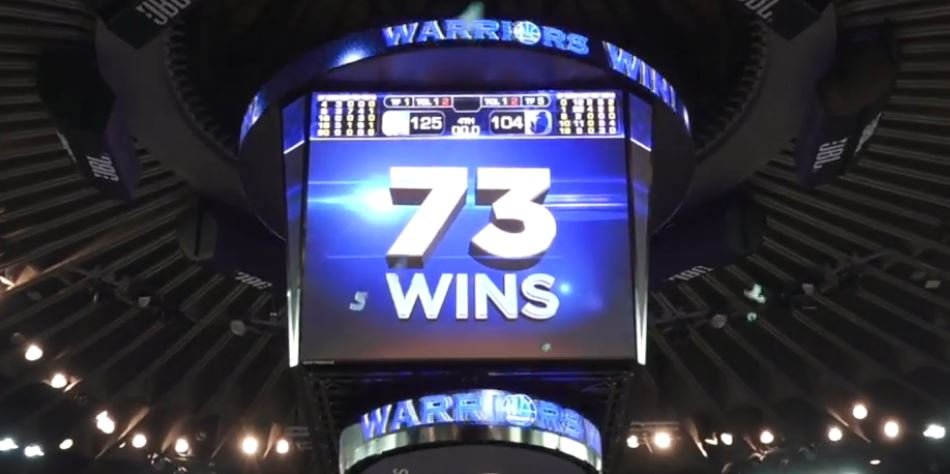
In their final regular-season game on April 13, 2016, the Warriors defeated the Memphis Grizzlies 125-104 to reach 73 victories. Curry lost forty-six points. He made ten shots from beyond the arc. That evening, Oracle Arena had a boisterous and sincere celebration.
The majority of Warriors fans would prefer to skip what came next. In the NBA Finals, Golden State lost three straight games to LeBron James and the Cleveland Cavaliers despite having a 3-1 lead. The championship, which would have made this season unbeatable, did not materialize.
In some circles, the regular-season record might have felt almost bittersweet due to the defeat. Even now, there’s a feeling that some people minimize what transpired during those 82 games by citing the Finals collapse. That seems unjust. It has never been more difficult to break a regular-season record in professional basketball.
The record stands alone at 73-9. unaltered. A figure that required a historically great player to play at his best for an entire season while being surrounded by the ideal teammates and receiving the ideal coaching. It’s genuinely unclear if it will ever break. However, it did occur. Additionally, Oracle Arena was as noisy as a basketball arena could get on that April night in 2016.
