

In basketball discussions, there is a certain type of disagreement that never goes away; it can only be intensified rather than resolved. That argument is to move the Golden State Warriors from 2015–16 to 2026. In light of contemporary offenses that frequently attempt 40 or more three-pointers per game and defensive strategies that are solely focused on taking advantage of the weakest player on the floor, it is worthwhile to consider whether that 73-9 team would survive or if nostalgia does the majority of the work.
In all honesty, it seems more likely that the Warriors will prevail. However, the case is not entirely clear. The shooting should come first. It was truly shocking to shoot 31.6 three-pointers per game in 2016. That number seems almost charming ten years later. Without much debate, average teams now clear 40 attempts per nite. The war has been won by volume.
However, Curry and Klay Thompson’s level of efficiency has not been duplicated in the modern game. With Curry shooting 45.4 percent from beyond the arc on more than 11 shots per game and Thompson adding 42.5 percent on eight or more, that backcourt combination is still uncommon in history.
High-volume offenses of today have accepted a trade-off: more attempts, greater variance, and about average accuracy. In 2016, Golden State used both superior accuracy and volume as weapons. That level of accuracy not only works but also punishes aggressive defensive rotations and modern drop coverages.
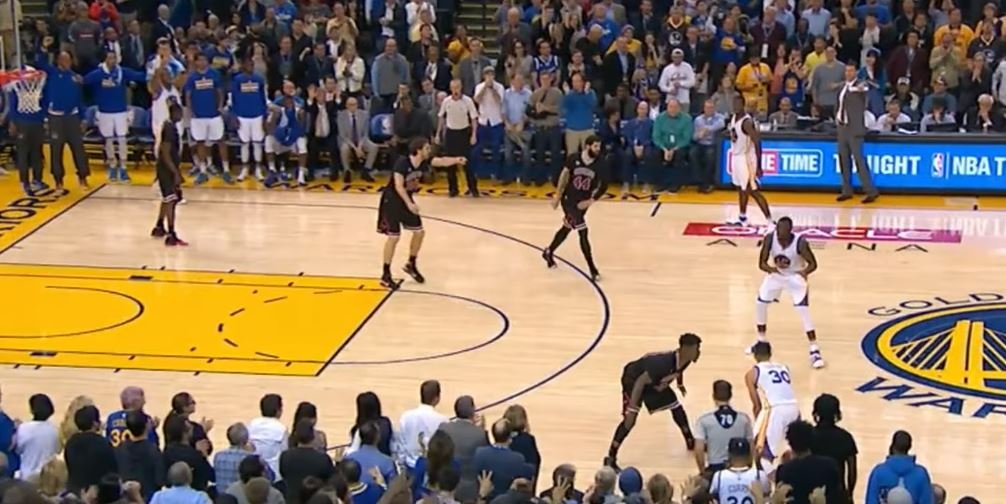
The Warriors’ construction feels almost purposefully ahead of its time on the defensive end, which is where things get truly interesting. Isolation hunting, or running screens until a defense’s weakest player ends up guarding a superstar in space, is the main strategic pressure in 2026. A player or two on most teams are unable to fulfilll that responsibility.
There were hardly any players for the 73-9 Warriors. The “Death Lineup” could switch one through five with little drop-off thanks to Draymond Green at center, Thompson and Andre Iguodala at the wings, and Stephen Curry becoming a more disciplined on-ball defender than most people recall. It is difficult to ignore how precisely that architecture corresponds to what contemporary offenses are intended to take advantage of.
In particular, Draymond would translate nearly flawlessly. The 2016 version of him, with his elite screener-coverage, roaming free safety, and lateral quickness comparable to most perimeter players, is essentially the model that analytically motivated front offices now attempt to build upon. Before the league made it mandatory, he was acting in that manner.
Nevertheless, it would be dishonest to ignore two genuine vulnerabilities. In comparison to what Curry frequently encountered in 2016, modern creation wings are larger and more physical. A 6-foot-7 ball handler who can post Curry, pull him through screens for 48 minutes, and put him in contested recovery situations is the focal point of a 2026 offense that generates real wear. After 2016, Curry’s defense significantly improved, but the current strategy of targeting smaller guards is more methodical and persistent than anything created during that time.
Draymond’s inability to shoot is the second pressure point. His career-high three-point shooting percentage of almost 39 percent in 2016 kept opponents guessing. Modern schemes would completely sag off of him if 2026 scouting concluded that number was unsustainable, obstructing Curry’s driving lanes and effectively making one of Golden State’s best players a liability. Whether 2016 Draymond could sustain that shooting under the scrutiny of modern preparation is still up for debate.
Nevertheless, the 73-9 Warriors were more than just a byproduct of a transitional period when considering the whole picture, which includes the historic shooting efficiency, the switchable defensive depth, and the pace that already matched contemporary league averages. They seem to have been created—possibly unintentionally—for the very environment that came after them. For ten years, the league tried to emulate Golden State’s success. It is important to keep in mind that they were never quite successful.
