

The way the Air Jordan 41 arrived was almost purposefully silent. No vintage hues. No callbacks to the past. There’s no need to rely on forty years of ancestry to carry out the heavy lifting. It didn’t need to be stated aloud when Jordan Brand unveiled the shoe in Shanghai on August 28: this is a different kind of Air Jordan release.
It’s important to pay attention to that. The line has been trading nostalgia for a long time and has made huge profits. nniversary colorways, retro releases, and callbacks to Concord, Chicago, and Bred. It’s all profitable and understandable. However, it seems like Jordan Brand decided it was time to make a performance statement once more after seeing the 41 land. Not a piece for a museum. An actual basketball shoe designed to fit the current style of play.
In certain ways, the construction reflects that intention. The Jordan line’s new nano print mesh upper, which is designed for lightweight containment and breathability, completely replaces the leather. While maintaining targeted support where a player truly needs it—during cuts, drives, lateral shuffles, and defensive possessions—the sophisticated woven structure lowers overall weight. It’s not just an esthetic change; it’s a significant material one.
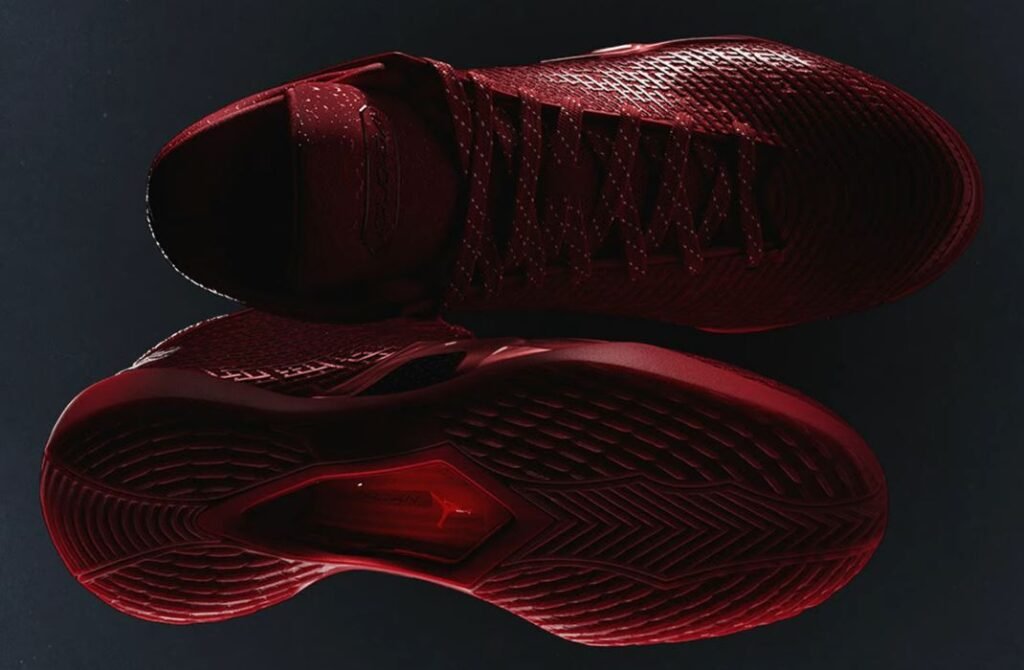
The objective was to create an upper that could move with the athlete without sacrificing the confidence and structure players require at the highest level, according to Senior Creative Director Leo Chang, who has worked across Nike basketball for 25 years. The nano print construction is their solution to the more difficult balance than it seems.
The most aggressive cushioning stack Jordan Brand has included in a performance shoe in a while is located beneath. A ZoomX midsole for lightness and energy return, a full-length Zoom Strobel for underfoot responsiveness, and an Air Zoom heel unit added especially for impact protection are all new in comparison to the Air Jordan 40.
According to reports, Michael Jordan’s own criticism, which was based on his focus on defense and the significance of remaining prepared to advance rather than stumbling, was the direct source of that heel addition. The court grip is covered by a full-length herringbone traction pattern, while stability is managed by a carbon fiber and TPU shank. When taken as a whole, it reads like a shoe created by individuals who genuinely considered what occurs during a 40-minute basketball game.
It’s the colorway strategy that makes things truly intriguing. The 41 is being introduced by Jordan Brand in six initial colors, each of which has a gemstone theme and is associated with a particular aspect of Michael Jordan’s life. His three championship runs with the Chicago Bulls are associated with the Ruby launch colorway. His birthstone will be the focal point of an amethyst version. An opal colorway pays homage to his college, UNC. Compared to the typical numbered-colorway method, this system feels more intimate and is thoughtful. It’s unclear if that narrative will appeal to consumers as much as a traditional Bred or Royal colorway, but at least it’s a thoughtful creative choice rather than a default.
The 41’s athletes, including Stephon Castle and Paolo Banchero, have spoken out about the shoe’s performance on the court. The best thing a basketball player can say about a shoe is that it allows him to play without worrying about what’s on his feet, according to Banchero. Through cuts and possessions, Napheesa Collier praised the confidence it gave her. These quotes are not empty platitudes. They have a certain quality that implies people wore the shoes during actual workouts before making any public statements.
The Air Jordan 41 will go on sale worldwide on October 25 and retail for $205 in adult sizes. This shoe might represent a real paradigm shift in Jordan Brand’s approach to performance footwear. Alternatively, the 41 might carve out its own quieter lane while the retro machine continues to run alongside it. In any case, the shoe is a serious item. It’s already obvious.
