

The majority of people lose the 73-9 Game in the same manner. A legendary team-season—possibly the 1996 Bulls or the 2016 Cavaliers—lands, the wheel spins, and a well-known figure leaps off the screen. They sign him. With four roster spots still unfilled and forty-five million dollars spent in a single transaction, the remainder of the draft suddenly becomes a damage control exercise. Over a million players have completed this free browser game without cracking 73 wins because of this well-known loop.
The setup is fairly simple. One $100 million budget, five spins, and five signings are all yours. You sign one player from the roster of a randomly selected NBA team from 1990 to the present. A prime superstar could take half of your money in a single move because each player is priced based on how much their contract would be worth in relation to the 2026 salary cap. A simulation that runs an 82-game season after all five spots are filled tells you how frequently your roster would truly defeat the 2015–16 Golden State Warriors, the team with the most victories in NBA history.
Math is an honest place to start for any real strategy. A baseline of $20 million per slot is obtained by dividing $100 million by five positions. That figure is helpful math, not an official target. It lets you know right away if a signing is using significantly more than their fair share of the initial investment. The majority of players don’t think like that. They think in terms of names. And that’s where the budget breaks down.
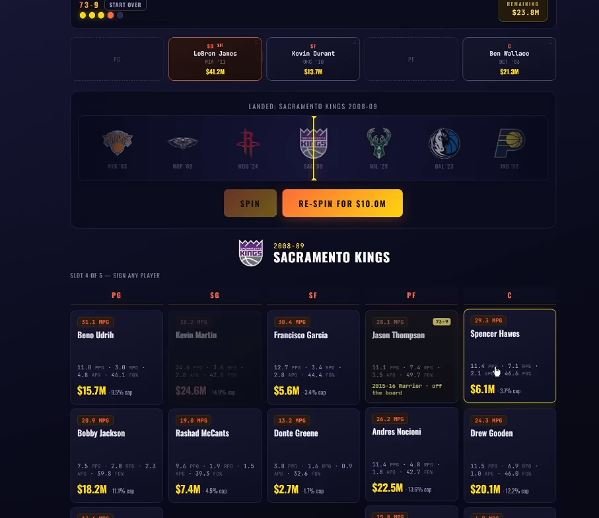
You become the best team when you have the best players, but they also make you poor. Nearly the whole bankroll, or $80 to $100 million, can be spent on a single superstar. A balance between star power and value signings is required by the budget. In one version of the game, you get a historically cheap pick early on, such as a rookie contract season from a player who went on to become elite, and all of a sudden you have $70 million left over for four spots. The version that offers you the most flexibility is that one. If you start with a $55 million signing, you will have to patch the roster by the fifth spin with whoever happens to be reasonably priced.
What this player adds, what the salary takes away from future options, which positions are still available, and whether a re-spin is worth losing an additional $10 million are all important questions to ask before making a signing. The final point is more important than most people think. Although it’s a purchase, the re-spin option, which costs $10 million to obtain a different team season on any spin, feels like a lifesaver. If you use it twice before signing anyone, you’ll have used up the equivalent of a whole roster spot. Sometimes it’s the right decision. On a whim, it’s rarely worthwhile.
The other factor that subtly undermines rosters is positional fit. You require a center, small forward, power forward, shooting guard, and point guard. Planning around which stars play where is important from the first spin because each signing fills its position slot. It’s simple to pile on wings and perimeter players without realizing that the paint needs to be covered. Even if a player is capable of filling several roles, the plan should monitor which positions are still available to prevent a final market where the only reasonably priced options are insufficient to meet the remaining roster requirements.
After the simulation completes, the game displays something truly helpful: the best lineup you could have put together using the same five team seasons and the same budget. The difference between your team and the best one is typically a few points per game, such as a star you overlooked for value or a less expensive wing that ought to have paid for a larger swing. Many players ignore that comparison because it is the most lucid feedback the game provides. They ought not to. It distinguishes between wheel luck and decision quality, showing you what you could have done differently with the particular cards you were dealt rather than what you did poorly overall.
Observing the community post their results online gives the impression that the players who perform the best aren’t the most knowledgeable about NBA history. They are the ones who have internalized the budget problem; instead of viewing each spin as a trivia question, they approach it as a resource allocation question. History, strategy, and luck all play a part in the game’s rewards. The wheel is out of your control. However, you have control over how you react to it, and the majority of runs are lost due to the first signing that seemed too good to pass up rather than bad luck.
