

A certain type of season does more than just win games; it alters people’s perceptions of what winning entails. One of those seasons was the Golden State Warriors’ 2015–16 campaign. The best regular season record in NBA history, with 73 wins and nine losses. And ten years later, that figure has taken on a new life as the focal point of a browser game that has attracted over a million players who are attempting to create something that can defeat it.
The Chicago Bulls’ 1995–96 record of 72 victories was surpassed by the Warriors, who finished 73-9 under head coach Steve Kerr. The record had been held for twenty years by that Chicago team, which was captained by Michael Jordan during what many still regard as the pinnacle of his career. On the final day of the regular season, Golden State defeated the Memphis Grizzlies 125-104 at Oracle Arena to pass it. That same nite, in the last game of his career, Kobe Bryant scored sixty points against the Utah Jazz. For the sport, it was a strange and unforgettable evening.
With their focus on three-point shooting and pace-and-space offense, the team, led by forward Draymond Green and the Splash Brothers duo of Stephen Curry and Klay Thompson, completely changed the game. It was the style, not just the victory, that set it apart from other dominant teams. Road crowds arrived early to witness the warm-ups. Oracle had the intensity of a postseason game on Tuesday nights. They made 73 a tale that people would tell for years, and the regular season felt like a parade.
Curry was the driving force behind it all. He became just the seventh player in NBA history to reach the 50-40-90 club by shooting 50.4 percent from the field, 45.4 percent from three, and 90.8 percent from the free-throw line. He became the NBA’s first unanimous MVP winner and broke his own record for the most three-pointers made in a season with 402, becoming the first player to ever surpass 400. Compared to what his peers were doing, those figures fall into a different category. Even now, it’s still a little difficult to fully comprehend.
Thompson had the best regular-season performance of any NBA player who wasn’t Stephen Curry at the time, averaging 22.1 points per game while shooting 42.5 percent from beyond the arc and making 276 triples. With the best net rating in the league at plus-18.9, Green averaged 14.0 points, 9.5 rebounds, and 7.4 assists per game. The detail that is often overlooked in the retelling is green. His presence on the floor made the entire system function in a way that is still hard to fully explain in statistics, even though he wasn’t the scorer that people were focusing on.
Additionally, the Warriors were the first team in NBA history to avoid losing back-to-back games for the entire season. Before Milwaukee finally caught them in December, they had a 24-game winning streak. They simply continued to win after that. Even though the San Antonio Spurs finished 67-15 and pursued them until the last two weeks of the schedule, they were still twelve games behind.
Naturally, the season ended poorly. In seven games, the Cleveland Cavaliers overcame a 3-1 deficit in the Finals. Cleveland’s lead was maintained by LeBron James’ chase-down block on Andre Iguodala in the final seconds of Game 7, and the Warriors’ historic regular season concluded without a championship. The question of whether Cleveland was just superior in those seven games or whether exhaustion from chasing 73 wins cost them in June remains unresolved.
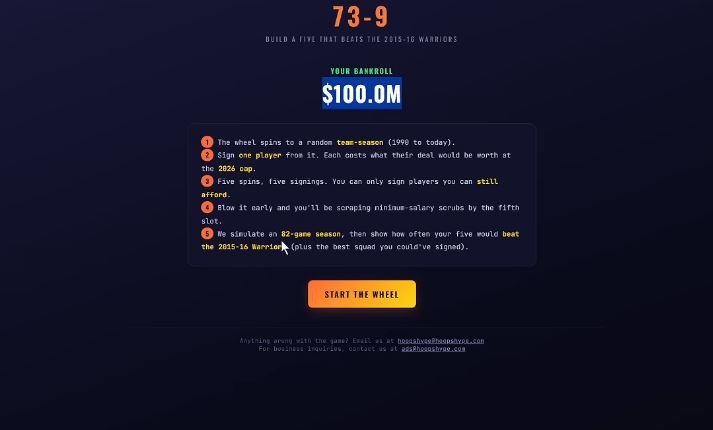
The HoopsMatic browser game, also known as the 73-9 Game, is the result of all of this. The idea is straightforward: $100 million, five arbitrary team seasons drawn from basketball history between 1990 and the present, five signings, and an 82-game simulation that indicates how frequently your lineup would defeat that Warriors squad.
The game calculates your team’s winning percentage against the legendary lineup of Curry, Thompson, Iguodala, Barnes, and Green; no one has yet to reach 73-9. In its first eighteen hours on the internet, the game received over a million plays. People still feel compelled to test themselves against that score, 73-9, as though defeating it in a simulation would resolve an unresolved issue from the 2016 Finals. X
Maybe no lineup ever makes it there. The Warriors that season weren’t put together in five haphazard selections; rather, they were developed over many years. However, the game continues to draw players, who spend their money, watch the simulation run, and fall short.
