

The idea seems fairly straightforward. You receive five picks, a spinning wheel, and $100 million. Create the best team you can, simulate an 82-game season, and see if your team can defeat the Golden State Warriors of 2015–16, who finished 73–9 and shattered the most revered record in NBA history. Simple, huh?
Not even near. Basketball fans have been subtly drawn into a fun and humble rabbit hole by HoopsMatic’s 73-9 Game. Beneath its seemingly simple appearance, this browser-based fantasy exercise contains a surprisingly insightful piece of basketball logic. A random team season from 1990 to the present is selected by spinning the wheel.
From that roster, you select one player. The cost of each player is equal to the value of their contract at the 2026 salary cap. Five signings, five spins. You’ll be scraping the minimum-salary bin by the fifth slot if you spend recklessly early, attempting to complete your starting five with a journeyman who peaked in 2009. The structure works because it has an almost cruel quality.
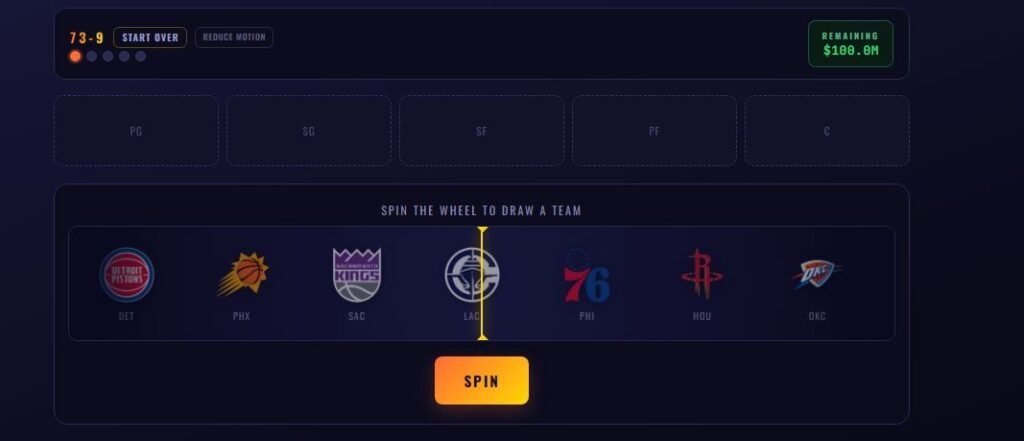
Every time, the first spin is thrilling. Shaquille O’Neal could be acquired by the 2001–02 Lakers. Alternatively, you could go after LeBron James of the 2016–17 Cavaliers. The wheel doesn’t give a damn about your preferences, and its randomness necessitates a kind of improvisational thinking that isn’t really required by traditional fantasy drafts. You are not creating your ideal team from the ground up. It’s actually more similar to how actual NBA front offices function than most fans would like to acknowledge: you’re constructing the best team you can from whatever situation you find yourself in.
Most people fall apart in silence when it comes to budget management. Contracts from the Supermax era are costly at the 2026 cap valuation. It can cost sixty or seventy million dollars to select a peak Giannis Antetokounmpo or a prime Kevin Durant, leaving you scrambling for inexpensive role players to complete the roster.
You need more than one star, especially when playing the 73-9 Warriors. Curry, Thompson, Draymond Green, Andre Iguodala, and a bench capable of outscoring entire starting lineups on a given nite were all part of that team. It won’t work to have one superstar surrounded by minimum contracts.
Perhaps this is the most honest and overlooked lesson in the game. Individual matchups—who can score on Draymond, who can guard Curry, and who can manage Thompson’s off-ball movement—are often the focus of discussions about defeating elite teams. Instead, the 73-9 Game makes you consider roster construction. It’s important to maintain balance. Depth is important. Generally speaking, it is a losing strategy to spend $80 million on two players and hope the simulation works out.
Once your five selections are confirmed, the simulation runs an 82-game season and generates results. It displays the number of times your assembled team would defeat the 73-9 Warriors, indicating that different results and lessons are learned from repeated playthroughs. In a simulation, a team that defeats the Warriors 60% of the time may seem successful until you see that someone else’s more balanced roster is winning 70% of the time. Additionally, the game displays the ideal squad, or the best five players you could have signed. This has the effect of either validating or subtly embarrassing your actual selections.
The 73-9 Game better conveys the extreme difficulty of what Golden State accomplished that season than nearly any other basketball argument format. It casts a different light on the record when you’re trying to assemble a team to defeat them with $100 million and no roster or era restrictions, and you’re still only winning half the time in simulations. These weren’t just 73 victories over opponents from the mid-2010s. With outstanding shooting, defense, depth, and a coaching staff that truly knew how to use it all, this team had virtually no vulnerabilities.
Hardcore NBA fans believe that the 73-9 record is overlooked because of the events that followed, such as the Warriors’ Finals loss to Cleveland, the signing of Durant, and the idea that they “needed help” to win titles. Almost unintentionally, the HoopsMatic game corrects that dismissal. The lesson starts to take a different turn when you spend twenty minutes trying to put together a team from NBA history that can consistently defeat them.
Genuine arguments are also generated by the game. Depending on what the wheel yields, friends playing in the same session will end up in entirely different locations. It is possible for one person to develop a disciplined defensive team that causes problems for the Warriors in the paint by lucking into a prime Tim Duncan at a young age. Another could acquire Curry from the 2015–16 roster and use the remaining funds to investigate his surroundings. Because of the randomness, no two games have the same atmosphere, and no two teams spark the same discussions.
It’s still unclear if HoopsMatic’s developers wanted the game to be a fun interactive time-waster or a deep basketball commentary tool. It works effectively as both. The concept is instantly clear, the interface is simple, and the learning curve is just high enough to keep seasoned players interested without overwhelming novices. Fundamentally, it’s asking one of the most genuinely fascinating questions in basketball—not who was the best player, but whether the best team can truly be defeated—and it’s relying on math rather than the loudest voice in the room to provide an answer.
It’s not as common as it seems. The majority of NBA debate formats prioritize confidence over precision. Building, perseverance, and a realistic grasp of what it takes to win 73 games in a season are all rewarded in the 73-9 Game. As it happens, it requires a lot. More than $100 million can consistently defeat more than most of us can recall.
Try it out. Most likely, you’ll lose. But by then, you’ll have a better understanding of the 73-9 season.
