

Only basketball fans are familiar with a particular type of frustration. You construct the roster in your mind; you have the components, the reasoning, and the background knowledge to support it. When the simulation runs, you get 58 victories. Technically, not too bad. However, it’s never 73.
The 73-9 Game, a free browser challenge created by HoopsMatic and HoopsHype that debuted in July 2026 and quickly amassed over a million plays in its first eighteen hours, revolves around this silent cruelty. The idea seems fairly straightforward. You receive $100 million to put together a starting five and attempt to defeat the Golden State Warriors of 2015–16, who finished with the best regular season record in NBA history (73-9). a single budget. Five places. No short cuts.
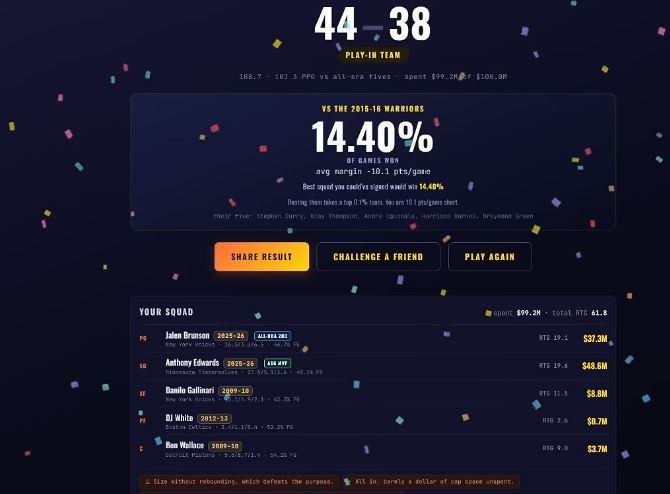
The problem is that you can’t simply choose your ideal roster by hand from all of basketball’s past. You sign one player from the roster of a random team-season from 1990 to the present, such as the 1996 Bulls, the 2004 Pistons, or the 2023 Nuggets.
Your team consists of five spins and five signings. The money is what makes it truly challenging and addictive. A prime superstar can eat up half of your money in a single move because each player is priced based on how much their contract would be worth in relation to the 2026 salary cap. You can get $47 million from Prime Michael Jordan. When that team season arrives, rookie Nikola Jokić will only be worth $2.4 million. The true strategy is found in the space between those two options.
You could spend the second half of the game searching for minimum-salary role players who are incapable of guarding anyone on that Warriors team after blowing your budget on a single elite pick in the first or second spin. It’s also possible to be cautious, spread the money, acquire reliable players at every position, and still fail because you didn’t swing big enough to compete with Draymond Green and Steph Curry running that offense. With lineups that included Tim Hardaway, Michael Jordan, Kevin Durant, Kevin Love, and Dwight Howard, players have shared results like 61% win rates. On paper, this is an incredibly impressive collection, but they were unable to secure 73 victories against a simulated version of that Warriors team.
The game determines the strongest legal five you could have built from the five team-seasons you landed on under the $100M cap—the best version of your particular wheel luck—after the simulation has finished. This is different from a basic random generator because of that feature. You can see the precise location of your wins on the table. The star you overlooked due to financial constraints. The name-brand option that consumed 40% of your cap space should have been replaced with the less expensive wing. It stings just right.
The simulation engine that powers the game generates a team-strength number based on each player’s actual per-game statistics and past minutes. An 82-game simulation and a head-to-head projection against the 2015–16 Warriors, who are in the top 0.1% of teams ever assembled, are based on that figure. That framing is important. You’re not merely attempting to assemble a strong team. You are attempting to construct something that is appropriate for that 0.1% discussion, which is a very different and challenging issue.
It doesn’t require an account, is free, and operates in your browser. It is compatible with mobile devices. There are eight languages available. There is a true reason behind the mechanics, but none of that explains why it spread so quickly. One of those teams that never quite made history is the 2015–16 Warriors. The greatest-team controversy has persisted for ten years because they won 73 games before losing to Cleveland in the Finals. The 73-9 game keeps the debate on a scoreboard. Take legends from thirty years of team seasons, toss them at that iconic core, and see how they hold up over the course of eighty-two games.
Additionally, you have the option to re-spin the wheel on any slot machine and obtain a different team-season by spending $10 million. A layer of gamble within gamble is added. Spend $10 million and hope for a better outcome in the next spin. Or use what landed and bank the money? The game’s $100M cap represents only roughly 64.7% of 2026 cap space, while the Warriors‘ actual starters used 95.2% of that era’s cap, according to some players. This inherent disadvantage makes matching their win total a truly difficult task rather than merely an enjoyable one.
As of right now, no one has consistently reported putting together a five that replicates previous 73 victories. Many have come very close. Many have reached 65, 68, and possibly 70 on a successful wheel run with prudent money management. However, the game appears to be intended to remind you of something the NBA itself demonstrated ten years ago: assembling a team strong enough to finish 73-9 is not something that happens by coincidence, by assembling the most well-known players, or by hoping the numbers work out. The real Warriors spent years perfecting the kind of balance needed for it.
Apparently, a million people were willing to keep failing at that lesson on the first day alone because The 73-9 Game managed to make it truly enjoyable to learn.
