

Nearly every Oklahoma City Thunder game has a moment that the broadcast misses. Something quieter has already occurred before the fast break even begins, before Jalen Williams is finishing at the rim or Shai Gilgeous-Alexander is slicing through the lane. There is a defensive plan in place. A ball handler has been directed in the wrong direction. Almost by design, a turnover has been created. That is the fundamental inversion of what Mark Daigneault has created in Oklahoma City: transition basketball, which appears chaotic but functions more like clockwork, and offense that starts with defense.
Daigneault, who turned forty this year, is not as well-known as some coaches. He doesn’t make much noise. He doesn’t control the sidelines in a way that attracts cameras. However, the Thunder are 10-1 to start the next season, have just won an NBA title, and play a style of basketball that most teams would take ten years to imitate. It’s difficult to ignore the connection between those facts and the man in charge of the operation.
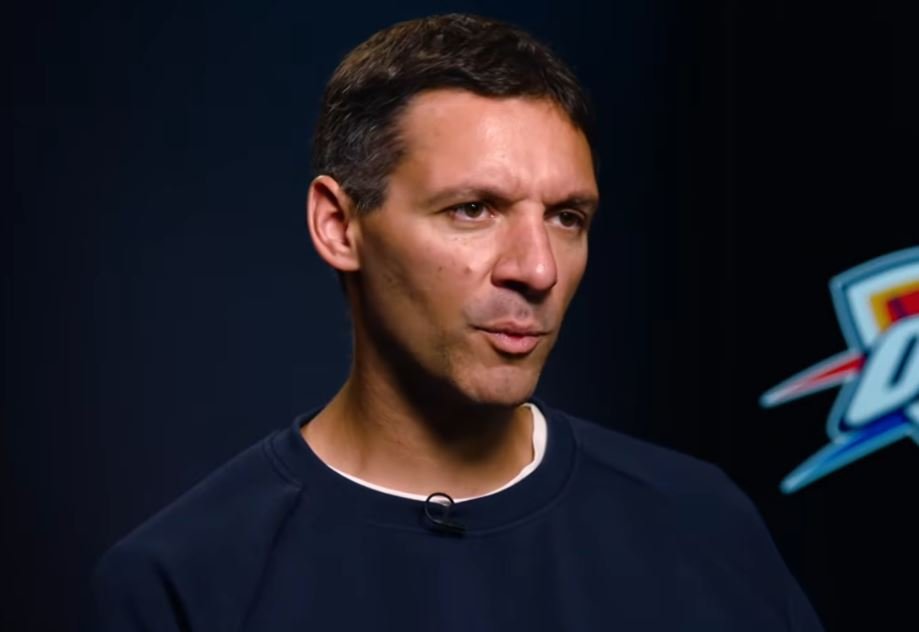
Pace for the sake of pace is not the foundation of OKC’s fast break. The pace is created by pressure. The Thunder’s defense is among the best in the league. In November of last year, Daigneault collaborated with ESPN’s Tim Legler to explain the fundamentals in public, which was noteworthy for a coach who typically doesn’t share his strategies. Swarm the ball-handler, force a turnover, and leave before the opponent can reset. The concept is fairly straightforward in theory but incredibly challenging in practice. The fast break isn’t really an offensive tactic, which is what makes it an inversion. It’s a defensive person dressed in offensive attire.
When Thunder center Isaiah Hartenstein appeared on The Rich Eisen Show, he provided insight into Daigneault’s strategies by mentioning that the coaching staff occasionally showed players videos of animals hunting prior to practices and games. not reels of highlights. Not tape for scouting. Animals are chasing. It sounds weird until you see the Thunder play, at which point it becomes almost apparent. They defend with a predatory patience that corresponds with precisely that type of framing: waiting, funneling, then exploding.
But it’s not the motivational strategies that make Daigneault’s approach truly intriguing. He doesn’t overcoach at all. He talked about giving his players a lot of freedom in a recent interview with The Athletic, purposefully resisting the urge to micromanage. “We give them a lot of ownership,” he remarked about the dynamic in the locker room.
He has shown a similar level of caution when it comes to Gilgeous-Alexander in particular, pointing out that he doesn’t really coach the current MVP anymore because he believes he can propel his own growth. That indicates either a great deal of confidence or something even more uncommon: a coach who genuinely understands when to move aside.
This season, Gilgeous-Alexander has changed. SGA is moving the ball earlier in possessions and more purposefully manipulating defenses rather than responding to them, according to Daigneault. In transition, that small change is more important than almost anywhere else. The Thunder’s fast break truly relies on a point guard who can read a defense before the ball is in his hands and make a pass off a turnover before the chaos settles. The tactical inversion is true: the more intelligently the offense reads, the more it appears to be a covert defense.
“Be Where Your Feet Are” and “Approach, Not Results” were the Thunder’s championship mantras years ago, and those cultural pillars have been subtly absorbed rather than demolished. The same approach was used at the organizational level when Daigneault chose to allow his players to fully unwind following their 2025 championship rather than rushing them into the next campaign, delaying training camp by about six weeks. The organism is the team. The organism requires room. If you push too quickly or too hard, you risk breaking something that was functioning.
Observing this team gives one the impression that they are still developing, which may be the most frightening aspect for the other teams in the league. The age of Chet Holmgren is 23. 24-year-old Jalen Williams is recovering from wrist surgery. A number of rotation pieces have failed to reach their ceiling. For his part, Daigneault appears unconcerned about it all. He has witnessed these players develop from prospects to champions, and he seems to have an understanding of development that few coaches are willing to acknowledge: the majority of it takes place outside of your presence.
The fast break is simply that philosophy’s most obvious manifestation. Pressure is created by defense. Chaos is the result of pressure. And OKC already knows exactly where to flee from the chaos.
