

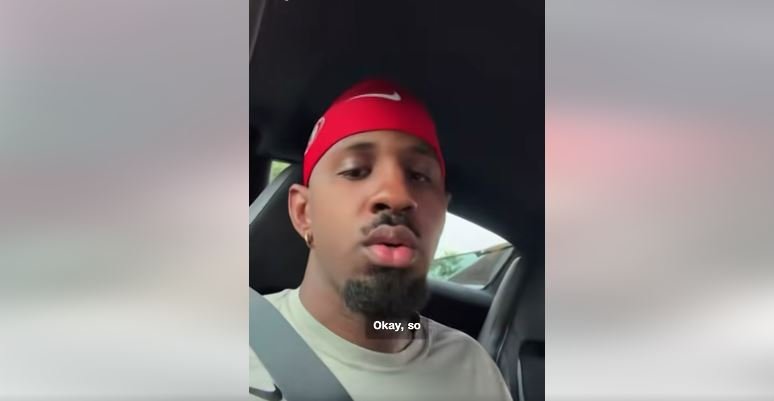
This story has a point where the focus keeps shifting. The arrest at Boise Airport is not the issue. Not even the $1.3 million is involved. In this brief video, which appears to have been shot by Daejon Love himself, he holds up a phone that displays a Google AI search result that identifies him as a wide receiver for the San Francisco 49ers. “That’s Google,” he says, glancing at the camera. That’s Google, not me.
Technically, he was correct. His bio was created by Google’s AI Overview; it sounded genuine and self-assured, the kind of thing that makes a suspicious woman put down her phone in the middle of her search. The issue is that Love was Google’s sole source, as federal prosecutors would subsequently clarify. Years of staged content, 49ers gear, training videos, and Instagram posts. The machine provided him with cover after he fed it.
On August 24, 2026, Daejon Labrayae Love, 35, and his alleged accomplice, Taylor Jamie Chan, 18, were taken into custody at an airport in Boise, Idaho. Both have been accused of wire fraud and conspiracy to commit wire fraud by federal prosecutors. Love is being moved to Oregon for additional court proceedings. The Justice Department claims that starting in February 2022, the scheme targeted at least 26 women in several states and took about $1.3 million in total.
The arrangement was deliberate and patient. Over the course of several years, Love established a social media presence on platforms like Instagram, TikTok, and LinkedIn, all of which bolstered a single myth: that he was an undrafted wide receiver for the 49ers, sidelined by injury, and quietly leading a prosperous life. The injury detail was astute. Before anyone could ask the obvious question, it provided an answer. He posted what appeared to be training footage, posed next to expensive cars, and showed up in team gear. Depending on the situation, he went by several names, including Jon Love, Jordan Love, and Avril Lyto Love.
The next stage was the dating app phase. On Tinder, Bumble, and Hinge, women would pair up with someone who spoke and looked like a wealthy professional athlete. Then Chan would show up, claiming to be Love’s financial advisor. They provided investment opportunities collectively. fake ones. The victims sent money with the hope of receiving a return because they were already emotionally invested in a man they thought was an NFL player. According to the FBI, Love would stop communicating as soon as money stopped coming in or inquiries began to mount.
One could watch all of this and concentrate primarily on the technical brilliance, such as the layered aliases, the staged content, and the AI manipulation. However, the case actually highlights something more unsettling: the level of credibility that the NFL name carries, even when used secondhand. A contract was not necessary for love. He was not required to be listed on a roster. All he needed was the jersey and sufficient internet infrastructure so that a Google search would feel valid.
There’s a feeling that the 49ers, who had no involvement at all, unintentionally became a prop in a long-running scam. Love allegedly sent a hair braider a message on Instagram at one point, stating, “I play for the 49ers btw, so I’ll need security when I’m there.” The requests were made with assurance. A fictitious career was the source of the confidence. Additionally, no one bothered to verify the posts that led to the fake career.
In a public commentary on the case, former NFL running back LeSean McCoy expressed his admiration in a manner that largely missed the mark. Charges of conspiracy and wire fraud have nothing to do with lifestyle inflation. They are about real money, real harm, and real people who trusted someone who had created a persona that was meant to be trusted.
The case is still evolving. More victims are likely, according to the prosecution. And now, for the first time, a man who constructed a fictitious NFL career from the ground up is incarcerated in an Idaho jail where he is completely unable to fake his way out.
